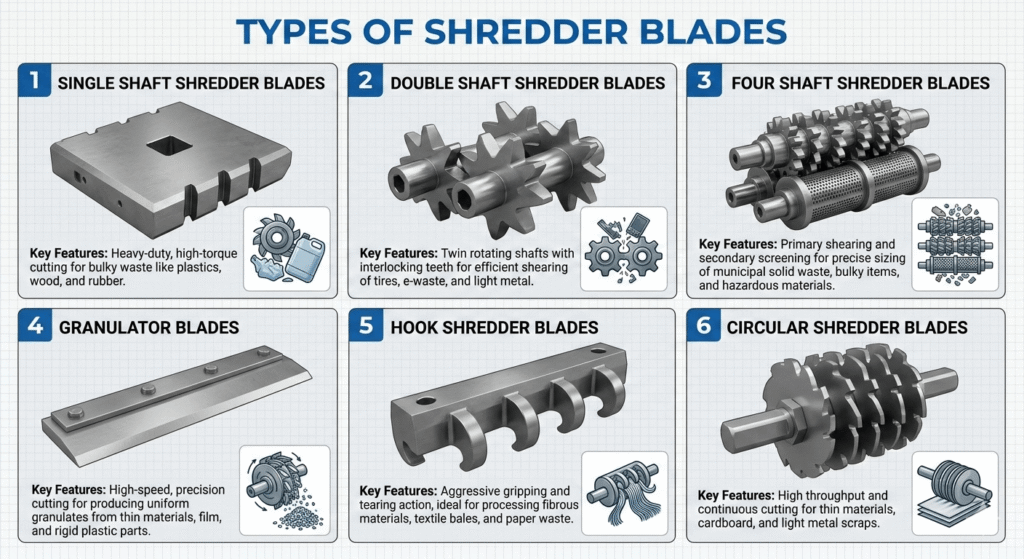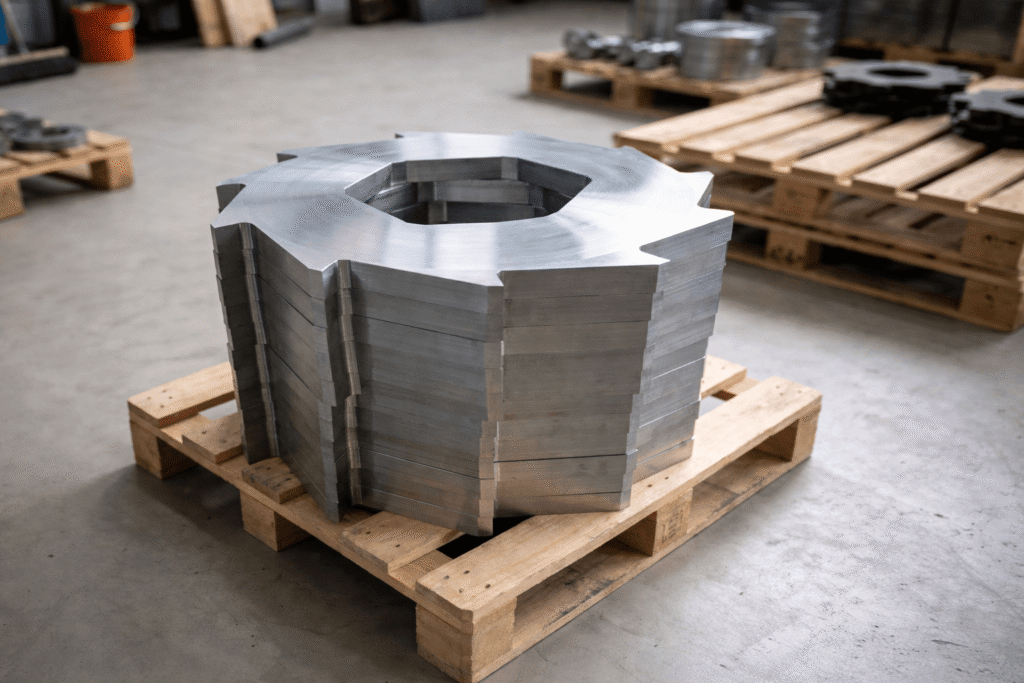
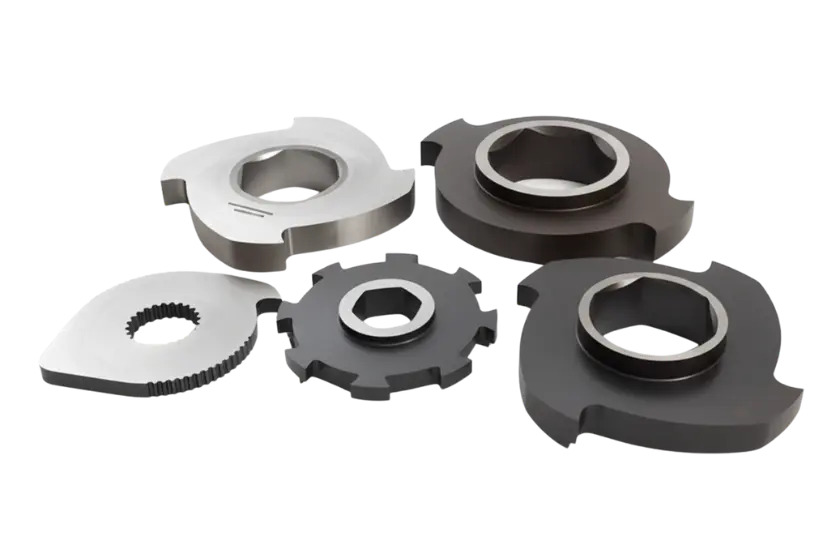
In modern recycling, waste management, and industrial processing, shredder blades remain the core component that determines performance, efficiency, and durability. As industries evolve in 2026, the demand for high-precision, wear-resistant, and application-specific shredder blades has increased significantly. We present a comprehensive guide to the top 10 types of shredder blades, detailing their structure, functionality, and industrial applications to help businesses achieve superior shredding results.
Types of Shredder Blades Overview
Comparison Table
| Blade Type | Structure | Ideal Applications in Industrial Shredding & Waste Management |
| Single-Shaft | Rotor with both moving and fixed blades | Plastics, textiles, cables, wood suitable for fine shredding |
| Double-Shaft | Dual shafts fitted with disc-shaped blades | Metals, tires, and bulky industrial waste |
| Four-Shaft | Two primary shafts with two secondary cleaning shafts | Secure shredding of e-waste, documents, and medical waste |
| Granulator | Combination of rotating and stationary blades | Plastic bottles, films, pipes, and general recycling |
| Hammermill | High-speed rotor equipped with swinging hammers | Industrial waste, metals, wood, and construction debris |
| Claw-Type | Symmetrically arranged claw-shaped teeth | Large plastics, barrels, pipes, and rigid materials |
| Hook Type | Blades featuring 1–4 hook designs | Woven bags, films, light plastics ensures easy material feeding |
| V-Type Cutting | Rotor with V-shaped blade configuration | Plastic profiles and pipes helps reduce clogging |
| Cross Cut | Dual-layer, cross-oriented blade system | Confidential paper, fabrics, and thin plastics for fine shredding |
| Segmented | Modular, replaceable blade segments | Tires, bulky waste, and heavy-duty industrial materials |
1. Single-shaft Shredder Blades
Features
Single-shaft shredder blades operate with a single rotating shaft equipped with multiple sharp cutting edges. These blades work in combination with stationary (fixed) blades to efficiently cut materials. A hydraulic pusher continuously feeds waste toward the rotor, ensuring smooth, consistent shredding performance.
They are capable of processing a wide range of materials, including plastics, rubber, wood, and cables.
Pros & Cons
Pros:
- Versatile can shred various materials such as soft plastics, wood, and rubber
- Low maintenance and relatively quiet operation
- Highly effective for plastic recycling applications
Cons:
- Blades wear out faster when processing hard metals and require frequent replacement
- Slower performance when handling large or very tough materials compared to other shredder types
Applications
Single-shaft shredder blades are commonly used for:
- Shredding plastic lumps, pipes, and films
- Processing rubber and wooden materials
- Cutting cables and textile waste
- Reducing material size for further recycling or processing
Single-shaft blades are widely used in recycling industries due to their flexibility and efficiency. The combination of rotating and fixed blades ensures precise and effective shredding across a variety of materials.
2. Double-shaft Shredder Blades
Features
Double-shaft shredder blades consist of two parallel shafts, each fitted with disc-shaped cutting blades. As the shafts rotate, the blades work together to grip, tear, and pull in large or tough materials. This design provides higher torque and greater shredding force, making it suitable for handling a wide range of waste types, including metals, tires, and bulky materials.
Pros & Cons
Pros:
- High power and strong cutting force
- Increased throughput for large-scale operations
- Capable of processing a wide variety of materials
Cons:
- Higher initial cost and maintenance requirements
- Requires more installation space
Applications
Double-shaft shredder blades are widely used across various industries, including:
- Plastic recycling plants for bottles and containers
- Tire recycling facilities for rubber processing
- Scrap yards for shredding metal waste
- Wood, e-waste, paper, textile, and food waste processing
- Construction and demolition waste management
These blades are ideal for heavy-duty shredding applications where strength, durability, and high capacity are essential.
3. Four-shaft Shredder Blades
Features
Four-shaft shredder blades are built with four powerful rotating shafts, enabling the machine to handle large, dense, and tough materials with ease. This advanced quad-shaft configuration ensures efficient cutting and continuous material flow. The integrated system reduces waste into uniform, small-sized particles in a single pass, eliminating the need for multiple processing stages. Additionally, a precision sizing screen retains materials within the chamber until they reach the desired dimensions, guaranteeing consistent and controlled output size.
Uses
Four-shaft shredders are widely used in industries that require secure and fine shredding. They are highly effective for processing electronic waste, hard drives, and medical waste, ensuring complete destruction. These machines are also ideal for shredding confidential documents, sensitive materials, and classified information, delivering maximum security and compliance with data protection standards.
4. Granulator Blades
Features
Granulator blades are designed with a combination of rotating (moving) blades and stationary (fixed) blades, working together to deliver precise and uniform size reduction. These blades operate at high rotational speeds, allowing for clean, smooth cuts and the production of consistent granules. Their sharp geometry and efficient cutting action make them especially suitable for plastic recycling applications, where accuracy and uniformity are essential.
Pros & Cons
Pros
- Produces uniform, consistent particle sizes
- Efficiently cuts both soft and rigid plastics
- Generates less dust and reduced noise when operated at optimized speeds
Cons
- Not suitable for processing metals or highly abrasive materials
- Requires frequent sharpening and maintenance to maintain performance
- Performs best with pre-sorted and clean materials
Uses
Granulator blades play a critical role in recycling facilities and manufacturing plants, particularly in plastic processing. They are widely used to shred and reprocess various types of plastic waste, including:
- Sprues, rejects, and plastic films
- Plastic profiles and containers
- Thin pipes, automotive bumpers, and lightweight components
- Waste from injection molding and formed plastic parts
- Pre-shredded plastics such as pipes and automotive scrap
Their ability to produce high-quality, reusable granules makes them essential for efficient plastic recycling and material recovery processes.
5. Hammermill Blades
Features
Hammermill blades consist of swinging hammers mounted on a high-speed rotor, delivering powerful impact forces to break materials apart. Instead of cutting, these blades rely on intense striking action to rapidly reduce waste. This design allows the machine to process a wide range of materials, including metal, wood, and construction debris. Hammermill blades are available in chisel, notched, or flat bar designs, depending on the application. For enhanced durability, manufacturers can apply special coatings or install wear-resistant liners, extending blade life and improving performance under heavy use.
Pros & Cons
Pros
- Provides high-speed shredding with strong impact force
- Capable of processing metal scrap, e-waste, and bulky materials
- Blades can be customized or upgraded for increased strength and durability
- Requires less frequent maintenance compared to some cutting-based shredders
Cons
- Produces a higher amount of fine particles (fines)
- Valuable materials may be lost within the fine output
- Not suitable for applications requiring precise or uniform particle size
Uses
Hammermill blades are widely used in applications requiring complete material destruction and aggressive size reduction. They are particularly effective for hard drive destruction, ensuring that sensitive data cannot be recovered. Additionally, these blades are used in metal recovery processes, where mixed waste is ground down until it passes through a screen, allowing for efficient separation and extraction of valuable materials.
6. Claw-Type Blades
Features
Claw-type blades are easily recognized by their distinctive claw-shaped design, which enhances their gripping and shredding capability. These blades are commonly used in dual-shaft and four-shaft shredders, offering versatility across different machines. Each blade is equipped with multiple claw points typically 3, 8, or 12 claws per blade, depending on the application. The claws are engineered not only to cut but also to tear, crush, and compress materials, ensuring efficient processing of irregular and bulky waste. This multi-action design improves material intake and enables consistent performance under heavy loads.
Pros & Cons
Pros
- Capable of shredding large, tough, and bulky materials
- Even force distribution enhances blade lifespan
- Highly effective for irregular, hollow, or uneven items
- Offers long service life when manufactured with high-quality materials
Cons
- Requires regular inspection and maintenance
- Generally heavier than standard cutting blades
Uses
Claw-type blades are widely used for processing a broad range of materials. Their design makes them particularly effective for industrial and mixed waste shredding.
| Claw-Type Blade Design | Best Materials for Shredding | Blade Material Options |
| 3-Claw, 8-Claw, 12-Claw | Waste plastics, rubber, wood, bulky waste, paper, carpets, cables, tires, WEEE | 9CrSi (soft materials), D2, SKD-11 (hard plastics, wood), 65Mn, Cr12MoV, HSS (high durability) |
7. Hook Type Blades
Features
Hook-type blades are distinguished by their one to four pronounced hooks, which are specifically designed to grip and pull materials into the shredding chamber. This unique geometry improves material intake and ensures a continuous, efficient feeding process, especially for bulky or irregular waste.
Pros & Cons
Pros
- Delivers fast cutting and tearing action, reducing materials quickly
- Designed for heavy-duty applications, improving overall productivity
- Enhances material feeding efficiency, minimizing blockages
Cons
- Requires frequent sharpening and inspection to maintain optimal performance
Uses
Hook-type blades are widely used in industrial applications for shredding woven bags, plastic films, and lightweight plastics. They are particularly effective for handling large, loose, or irregularly shaped materials, where consistent feeding is often a challenge. The hook design ensures that waste is firmly gripped and drawn into the machine, making the shredding process faster, smoother, and more efficient.
8. V-Type Cutting Blades
Features
V-type cutting blades are engineered with a distinct V-shaped geometry, designed to guide materials toward the center of the cutting chamber. This configuration prevents waste from spreading unevenly and ensures stable, controlled feeding during operation. The V-shape also plays a crucial role in reducing blockages and minimizing clogging, allowing for smoother and more efficient shredding performance.
Pros & Cons
Pros
- Enables fast and efficient cutting performance
- Reduces the risk of clogging during operation
- Highly effective for long, hollow, or irregular materials
- Produces uniform and consistent output sizes
Cons
- Not suitable for processing metal or highly rigid materials
- Requires precise alignment and setup for optimal performance
Uses
V-type cutting blades are widely used in industrial applications that involve plastic processing and recycling. They are particularly effective for shredding plastic pipes, tubes, and profiles, where maintaining consistent feeding is essential. These blades are commonly selected in recycling facilities handling long or hollow waste, as the V-shaped design helps draw materials inward and ensure rapid, efficient cutting.
9. Cross Cut Blades
Features
Cross cut blades operate through a two-stage shredding process, where blades move in multiple directions to cut materials both horizontally and vertically. This action reduces materials into very small, confetti-like particles, ensuring thorough destruction. The system typically consists of two layers of blades arranged in a cross pattern, with each layer progressively cutting the material into finer pieces for maximum size reduction and security.
Pros & Cons
Pros:
- Produces extremely small, confetti-sized particles for high-security shredding
- Delivers quiet operation with efficient performance
Cons:
- Requires regular cleaning and lubrication to maintain sharpness and efficiency
Uses
Cross cut blades are ideal for applications requiring secure document destruction. They are widely used to shred confidential papers, financial records, and bank statements, ensuring sensitive information is completely destroyed. These blades are commonly found in offices, financial institutions, and organizations that prioritize data protection and privacy compliance.
10. Segmented Blades
Features
Segmented blades are designed with a modular structure, allowing each individual blade segment to be replaced independently. This configuration simplifies maintenance and significantly reduces downtime, as damaged sections can be changed without removing the entire blade assembly. These blades are manufactured from high-strength alloy materials, providing excellent wear resistance and durability when processing tough and abrasive waste. Their robust construction ensures reliable performance in demanding industrial environments.
Pros & Cons
Pros
- Allows quick replacement of individual blade segments
- Reduces maintenance costs and downtime
- Capable of handling large, heavy, and mixed waste materials
- Suitable for processing a wide range of materials
Cons
- Requires precise alignment and setup for optimal efficiency
- May need additional space to accommodate modular blade configurations
Uses
Segmented blades are widely adopted across industries that demand high-efficiency shredding and easy maintenance. Their flexibility and durability make them a preferred choice for large-scale operations.
| Industry | Reason for Benefit | Materials Processed / Features |
| Waste Management & Recycling | Handles diverse and heavy materials efficiently supports material recovery and regulatory compliance | Plastics, metals, e-waste, wood, rubber, paper, cardboard enables recovery of precious and rare earth metals |
These blades are essential for operations requiring continuous performance, cost-effective maintenance, and versatility in processing complex waste streams.
Choosing the Right Shredder Blade
Selecting the appropriate shredder blade for your application is essential for achieving maximum efficiency, longer blade lifespan, and reduced operational costs. The right choice ensures smooth performance, consistent output, and minimal downtime. The table below provides a quick reference to help you identify the most suitable blade type based on your material and application.
| Application Scenarios | Recommended Shredder Blades |
| Plastic film / Woven bags | Hook-Type / V-Type Blades |
| Metal / Aluminum | Double-Shaft / Hammermill Blades |
| Rigid plastic pipes | Single-Shaft / Claw-Type Blades |
| E-scrap (Electronic Waste) | Four-Shaft / Cross Cut Blades |
| Tire rubber | Double-Shaft / Segmented Blades |
Choosing the correct blade type allows operations to optimize cutting performance, minimize wear, and handle materials more effectively. Each blade design is tailored to specific material characteristics, ensuring reliable and cost-efficient shredding results.
If you have any questions or specific requirements regarding shredder blades, please do not hesitate to contact us. Our team of experts is fully prepared to deliver tailored, end-to-end shredder blade solutions designed to meet your exact operational needs.