
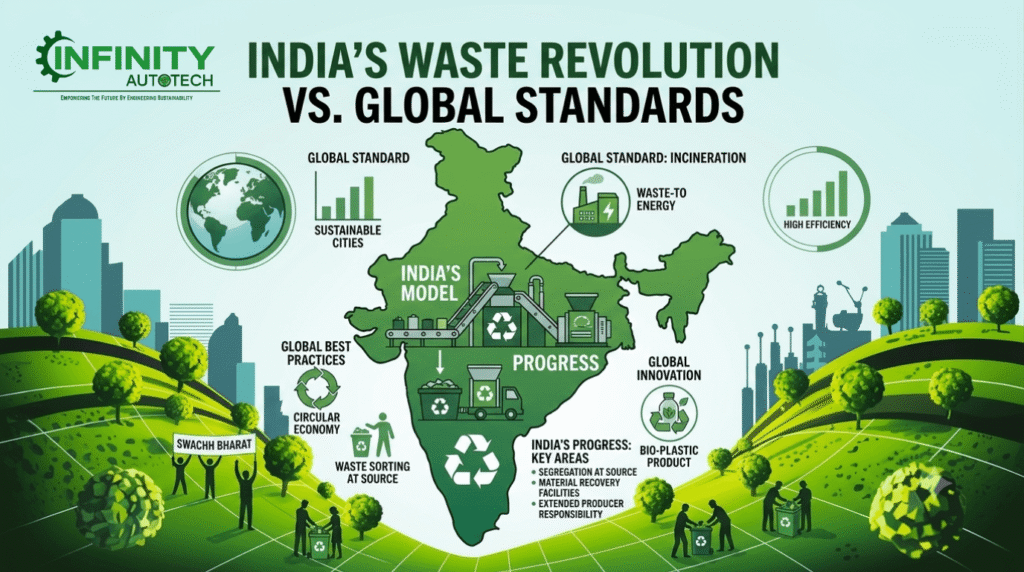
India generates a huge amount of waste every day, and managing it has become one of the country’s biggest environmental challenges. Rapid urbanization, population growth, and rising living standards have all contributed to increasing amounts of household and commercial waste. Today, Indian cities produce more than 150,000 metric tons of municipal solid waste each day, and this figure is expected to grow further in the coming years. As a result, improving waste management has become an important priority for both the government and local authorities.
A major step in this direction was the launch of the Swachh Bharat Mission in 2014. The campaign initially focused on improving sanitation and eliminating open defecation, but its scope gradually expanded. Under Swachh Bharat Mission–Urban 2.0, greater attention has been given to scientific waste management, recycling, and making cities garbage-free. Across the country, old dumping grounds have been cleared, waste processing plants have been built, and many cities have strengthened their waste collection systems.
The government has also introduced policies to reduce the amount of waste ending up in landfills. One important development is the Solid Waste Management Rules, 2026, which came into force on 1 April 2026 and replaced the earlier 2016 rules. These rules require households to separate waste into four categories: wet waste, dry recyclable waste, sanitary waste, and domestic hazardous waste. Proper segregation at the source makes recycling easier and improves the efficiency of waste treatment.
Another important feature of the rules is Extended Producer Responsibility (EPR), which makes manufacturers responsible for collecting and managing the waste created by their packaging. This encourages companies to recycle more materials instead of relying only on disposal. Although India still faces many challenges, progress is visible. A much larger share of municipal waste is now processed scientifically than it was a decade ago. Many public places, including parks, markets, and riverfronts, are cleaner than before, and community organizations, self-help groups, and local residents are playing a greater role in keeping their neighbourhoods clean.
India has also adopted practical solutions that suit local conditions. Biogas plants convert kitchen waste into useful energy, while large projects are removing decades-old garbage dumps that have polluted the environment. Rules governing plastic and electronic waste have become stricter, encouraging greater recycling and increased use of recycled materials in packaging.
Electronic waste has reached around 14 lakh metric tons each year. Although more of this waste is now processed through authorised recycling facilities, a significant share is still handled by the informal sector, where workers often lack proper safety measures.
How India Compares with Other Countries
Several countries have spent decades building highly effective waste management systems. Germany recycles more than 60% of its municipal waste through strict segregation and the Green Dot system, under which companies help pay for recycling their packaging.
Japan produces relatively little waste per person and combines careful waste separation with recycling and waste-to-energy technology. Sweden and South Korea have also developed advanced systems that recover energy and valuable materials from household and electronic waste.
These countries generally perform much better than India in international environmental rankings because they have stronger infrastructure, stricter enforcement, and greater public participation. In many of them, less than 5% of municipal waste is sent to landfills, with the rest being recycled, composted, or converted into energy.
India, however, has one important advantage. People in Indian cities generate much less waste per person around 370 to 500 grams each day compared with roughly 1 to 2 kilograms in countries such as the United States and Denmark. This provides an opportunity to develop a more sustainable waste management system before waste generation reaches much higher levels. At the same time, several challenges remain.
Waste segregation is still inconsistent, collection systems vary from one city to another, and safe disposal facilities are not available everywhere. Informal waste pickers continue to recover large amounts of recyclable material, but many of them work in difficult conditions without adequate protection or recognition.
Major Challenges
Managing waste in a country as large and diverse as India is never simple. Different states and cities face different problems, and many smaller towns still lack modern treatment plants. Even where such facilities exist, recycling becomes difficult if waste is not separated properly before collection.
Another major concern is the large number of old landfill sites that continue to pollute nearby land, water, and air. Open burning of waste remains common in some places, releasing harmful smoke into the atmosphere. During the monsoon, plastic waste often blocks drains, increasing the risk of flooding and the spread of water-borne diseases.
Although policies such as Extended Producer Responsibility have improved accountability, meeting recycling targets remains a challenge. Countries like Germany and Japan built their waste management systems gradually through long-term investment, public awareness, and strict enforcement of environmental laws. India must achieve similar progress while also dealing with rapid urban growth, poverty, and the demands of economic development.
New Ideas and Future Opportunities
Despite these challenges, there are many reasons to be optimistic. Cities such as Indore and Surat have shown that better planning, modern technology, and public participation can significantly improve waste management. GPS-enabled collection vehicles, digital monitoring systems, and improved sorting facilities have helped these cities consistently perform well in national cleanliness rankings.
India’s informal recycling sector also represents an important opportunity. With better training, improved working conditions, and formal recognition, waste pickers could become an even stronger part of the country’s recycling system while improving their own livelihoods.
Composting units, biogas plants, and waste-to-energy projects are also becoming more common, reducing the amount of waste sent to landfills while producing useful energy and organic manure. Investments in green technology and cooperation with international partners are helping many cities modernise their waste management systems.
Plastic and electronic waste also present opportunities for economic growth. Expanding formal recycling industries can recover valuable metals and raw materials, create employment, and reduce dependence on imported resources. Many cities are also experimenting with zero-waste initiatives and circular economy projects that could be adopted in other parts of the country.
Conclusion
India has made noticeable progress in waste management over the past decade. Cleaner public spaces, stronger environmental policies, and greater public awareness show that positive change is possible. However, much more work is needed to improve waste segregation, expand recycling infrastructure, strengthen enforcement, and encourage people to adopt better waste disposal habits.
While technology and government policies play an important role, lasting success ultimately depends on public participation. As concerns about pollution, climate change, and resource conservation continue to grow, effective waste management will become even more important. If India continues to build on its recent achievements, it has the potential not only to solve its own waste management challenges but also to provide valuable lessons for other developing countries.