In the world of industrial recycling and waste management, shredder blades are the unsung heroes that determine whether your operation runs efficiently or grinds to a costly halt. Whether you are processing plastic scrap, electronic waste, or bulk industrial materials, the quality of your shredder blades directly impacts throughput, energy consumption, and long-term operating costs.
This comprehensive guide explores everything you need to know about industrial shredder blades from materials and engineering to applications and maintenance – so you can make the most informed decision for your facility.
What Are Industrial Shredder Blades?
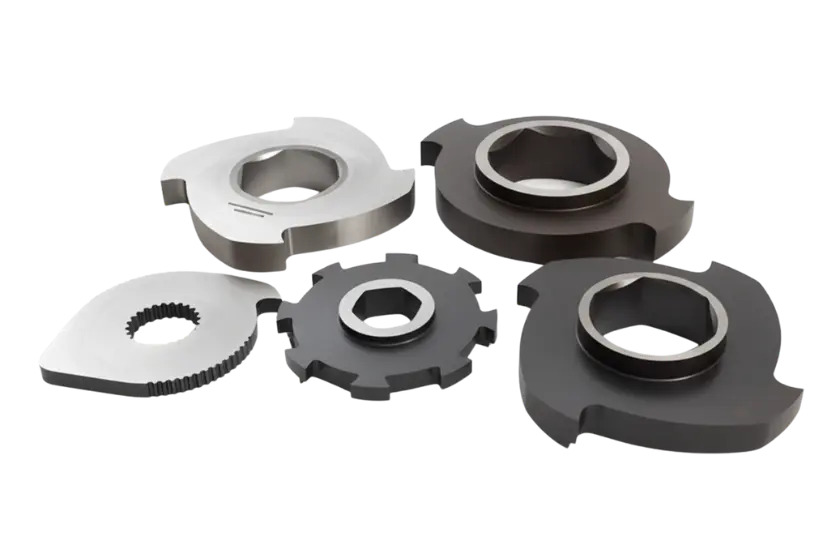
Industrial shredder blades also called shredder cutters or shredder knives are precision-engineered cutting components mounted on the rotating shafts of shredding machines. They work by applying immense shear and compressive forces to break down materials into smaller, manageable pieces.
Unlike consumer-grade shredders, industrial shredder blades are built to withstand continuous, heavy-duty operation. They must maintain their cutting edge even when processing abrasive, contaminated, or exceptionally dense materials day after day, shift after shift.
Why Blade Quality Matters More Than You Think
The blade is the single most critical wear component in any shredding system. A substandard blade creates a chain reaction of problems:
- Faster dulling, requiring more frequent sharpening or replacement
- Higher energy consumption as the motor works harder against blunt edges
- Inconsistent particle size output, affecting downstream processing quality
- Increased vibration and mechanical stress, shortening machine lifespan
- Unexpected downtime that disrupts production schedules and revenue
Investing in premium-grade shredder blades is not simply a purchasing decision – it is a strategic operational choice that pays dividends in uptime, efficiency, and total cost of ownership.
Materials and Engineering: What Sets Premium Blades Apart
Not all steel is created equal. Premium industrial shredder blades are manufactured from specially formulated tool steels and high-alloy materials engineered to balance hardness, toughness, and wear resistance.
Key Material Properties
- High hardness (typically 58–65 HRC): Resists edge wear and maintains sharpness longer under continuous loading
- High toughness: Prevents chipping or cracking when encountering unexpected hard objects or contaminants
- Wear resistance: Special carbide-forming alloy elements (chromium, molybdenum, vanadium) dramatically extend service life
- Heat resistance: Thermal stability prevents dimensional changes during extended high-speed operation
- Corrosion resistance: Protects integrity when processing wet, contaminated, or chemically active materials
At Infinity Autotech, our blades use premium-grade steel compositions – such as EH C 500 LE – engineered specifically for high-impact, abrasive shredding environments. The result is a blade that delivers measurably longer service intervals between sharpenings and replacement cycles.
Applications: Where Infinity Autotech Shredder Blades Excel
Our shredder blades are engineered to perform across the most demanding industrial applications. Here is a closer look at the environments where they deliver the greatest value:
1. Plastic Recycling Operations
Plastic materials such as PET bottles, HDPE piping, PVC sheets, and post-consumer packaging present a wide spectrum of hardness and density. Our blades are fully compatible with these materials and more, ensuring clean, consistent cuts that optimize output quality for downstream processing or direct resale of shredded flakes. The blade geometry and steel grade are configured to handle both rigid structural plastics and flexible film materials without sacrificing performance.
2. Electronic Waste (E-Waste) Processing
Electronic waste is among the most challenging materials for any shredding system. Hard drives, circuit boards, batteries, cables, and mixed electronic components contain metals, glass, and composite materials that demand exceptional blade toughness. Our precision-engineered blades handle WEEE streams effectively, producing consistent particle sizes that are critical for efficient material separation, metal recovery, and regulatory compliance in e-waste processing.
3. Continuous High-Volume Industrial Processing
For facilities running 24/7 processing rubber, textiles, wood, or mixed industrial scrap blade longevity is everything. Our blades are designed to minimize the frequency of sharpening and replacement cycles. This translates directly to maximum machine uptime, reduced maintenance labor costs, and higher overall facility throughput.
Key Features of Infinity Autotech Shredder Blades
Our blades are engineered with a clear focus on operational efficiency and long-term value:
- Durable Material Composition: Premium-grade steel and alloys deliver long-lasting performance and dramatically reduced replacement costs compared to standard blades.
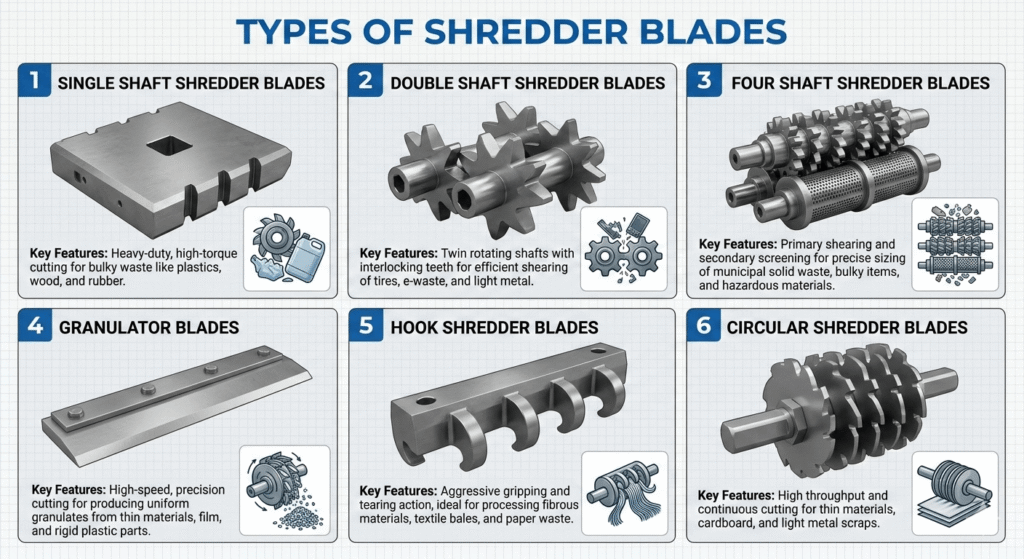
- Versatile Size Range: Available in tailored dimensions to fit different shredder models, shaft configurations, and throughput capacities — from compact single-shaft machines to large industrial twin-shaft systems.
- Precision Engineering: Every blade is meticulously manufactured to tight dimensional tolerances, ensuring optimal cutting geometry, balanced rotation, and consistent particle size output.
- Broad Material Compatibility: Compatible with PET, HDPE, PVC, e-waste, rubber, textiles, and more offering maximum operational flexibility for recycling and processing facilities.
- Custom Solutions Available: We configure blade solutions to meet your specific throughput targets, material profiles, and durability requirements, so you get blades built for your exact application.
- Energy Efficiency: Sharper, precisely engineered blades reduce the cutting force required – which translates directly into lower motor load, reduced energy consumption, and operating cost savings.
Selecting the Right Shredder Blade for Your Application
Choosing the correct shredder blade is not a one-size-fits-all decision. Several factors must be carefully evaluated:
- Material type and hardness: Softer materials like plastic film require different blade geometries than rigid HDPE or metal-contaminated e-waste.
- Required output particle size: Finer shred sizes typically require more aggressive hook angles and tighter blade spacing.
- Throughput volume: Higher tonnage applications demand superior steel grades and heat treatment for extended service life.
- Shredder machine model: Blade dimensions, bore size, and keyway configuration must match OEM specifications or engineered equivalents.
- Operating environment: Wet, corrosive, or high-temperature environments may require special surface treatments or alloy selections.
Our technical team works closely with customers to evaluate all these parameters and recommend or custom-engineer the right blade configuration — not just a standard off-the-shelf product.
Blade Maintenance: Maximizing Service Life
Even the best shredder blades require a systematic maintenance approach to achieve their maximum service life. Here are the critical maintenance practices every facility should follow:
- Regular inspection: Check blade edges for chipping, micro-cracking, or uneven wear after every major production run.
- Scheduled sharpening: Re-sharpen blades before they become dull enough to require excessive motor torque — early intervention preserves more base material per sharpening cycle.
- Proper torque on fasteners: Over-tightened or under-tightened blade bolts cause vibration, accelerated wear, and potential catastrophic failure.
- Contaminant monitoring: Metal contaminants entering the shredder are the leading cause of sudden blade damage. Magnetic separators and pre-screening systems are strongly recommended.
- Rotation and flipping: Many blade designs can be flipped or rotated to present a fresh cutting edge, effectively doubling or tripling service life between replacements.
- Storage: Store spare blades in a clean, dry environment with light protective oil coating to prevent corrosion.
The True Cost of Blade Ownership
Many procurement managers focus on unit price when purchasing shredder blades. This is a costly mistake. The true cost of blade ownership extends far beyond the purchase price:
- Replacement frequency: A cheaper blade replaced three times as often is not cheaper – it is more expensive in materials, labor, and downtime.
- Energy cost per ton processed: Dull or poorly engineered blades increase motor load, adding measurable kWh costs to every ton of material processed.
- Downtime cost: Every blade replacement or unplanned maintenance stop has a real cost – calculated in lost processing capacity and labor hours.
- Machine wear: Substandard blades introduce vibration and uneven loads that accelerate bearing wear, shaft wear, and frame fatigue.
When evaluated on total cost of ownership, premium Infinity Autotech shredder blades consistently deliver superior economic value compared to lower-cost alternatives.
Why Choose Infinity Autotech for Shredder Blades?
Infinity Autotech is not simply a blade supplier. We are an industrial recycling equipment specialist that understands the full operational context in which our products perform. This means we bring a systems-level perspective to blade design, specification, and support — not just component-level thinking.
- Precision manufacturing to tight dimensional tolerances ensures perfect fit and balanced rotation
- Premium steel alloys – including specialized grades like EH C 500 LE – for maximum hardness and toughness
- Full compatibility with major shredder brands and custom configurations for non-standard machines
- Applications engineering support to match blade design to your specific material and throughput requirements
- Commitment to sustainability: our solutions are designed to reduce waste, energy consumption, and material loss across recycling operations
Conclusion
In an industry where margins depend on uptime, throughput, and operational efficiency, shredder blade quality is not a minor detail – it is a strategic factor. The best recycling and waste processing operations understand that cutting corners on blades costs far more in the long run than it saves on the purchase order.
Infinity Autotech shredder blades are engineered to give your operation a genuine competitive edge: more uptime, lower energy cost per ton, consistent output quality, and fewer maintenance disruptions.
Ready to upgrade your shredding performance? Contact our team today to discuss your application requirements and receive a customized blade recommendation and quote.